Millions of Americans Over 40 Are Quietly Losing the Use of Their Hands — And Most Won't Realize It Until the Damage Is Permanent
A hand and nerve specialist reveals the hidden link between arthritis and carpal tunnel — and the 15-minute miracle that's making Big Pharma's lawyers nervous.
 October 27, 2026 | 11:11 am EST
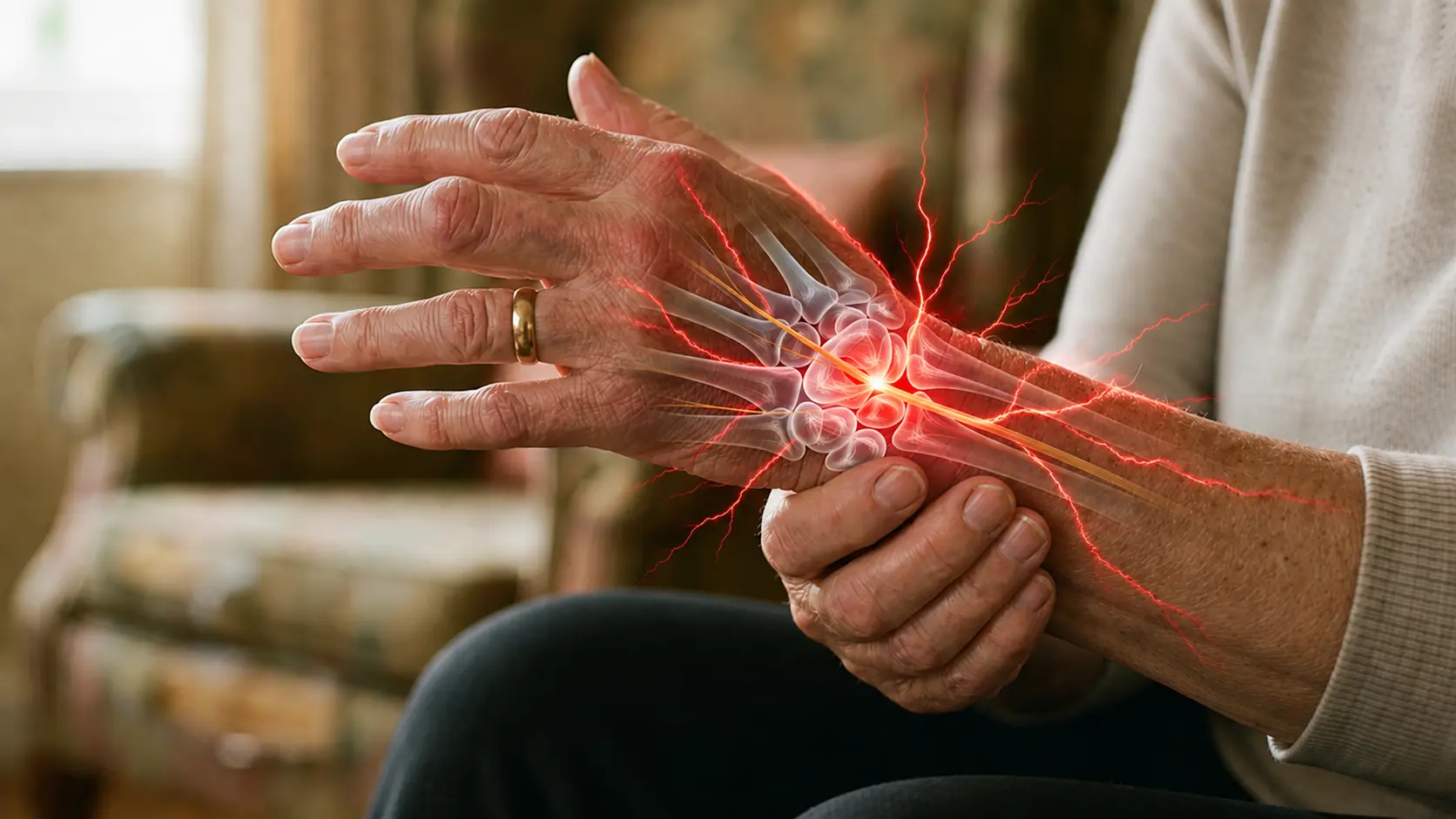
For millions of Americans, simple tasks like holding a coffee cup have become a daily struggle.
Dear reader,
I'm going to describe something, and I need you to be brutally honest with yourself about whether it sounds familiar.
You're lying in bed at 2 AM. Your eyes snap open — not because of a noise, not because of a nightmare — but because your fingers have gone completely numb. Your thumb, your index finger, your middle finger. They feel like they belong to someone else.
You do what you always do. You shake your hand out, flick your wrist, hang your arm off the side of the bed. The tingling fades. You fall back asleep.
Until it happens again two hours later.
During the day, it's different but no less maddening. That pins-and-needles sensation when you hold your phone. The dull ache that creeps from your wrist into your forearm, up into your elbow. The stiffness in your knuckles every single morning — like your fingers have been dipped in concrete overnight.
Maybe it's the swollen joints that scare you most. Your wedding ring doesn't fit anymore. Your knuckles are visibly thicker than they were two years ago. You hide your hands when someone reaches out to shake them because you're afraid of the pain — and the embarrassment.
Or maybe it's the sudden, sharp "electric shock" that shoots through your fingers when you least expect it — while gripping the steering wheel, lifting a grocery bag, or trying to button your shirt.
And here's the thing that probably confuses you most: your doctor can't seem to give you a straight answer. One says "arthritis." Another says "carpal tunnel." A third says "it's just age, learn to live with it." You've been handed three different diagnoses and zero real solutions.
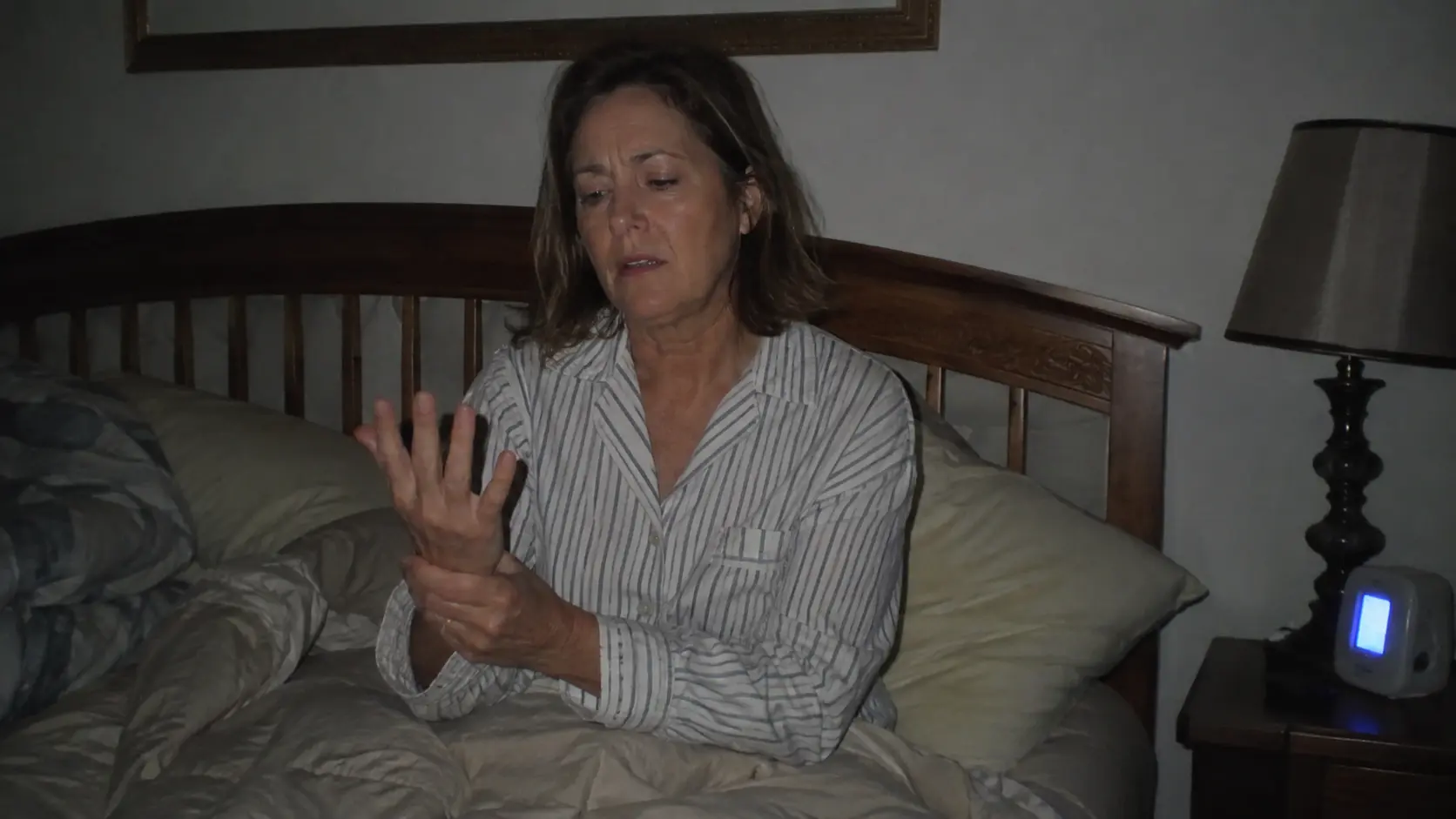
2 AM wake-ups from hand numbness affect over 8 million Americans every night.
If you just read that and thought "How does this person know exactly what I'm going through?" — keep reading. Because what's happening inside your hands right now is far more serious than anyone has told you. And the window to fix it is smaller than you think.
My name is Dr. David Reeves. I've spent 22 years as a hand and nerve specialist. I've examined over 14,000 patients. And I need to tell you something that most doctors won't, because frankly — it's not in their financial interest to say it.
That tingling, that numbness, that stiffness, that swelling you feel in your hands? Whether your doctor has called it carpal tunnel, arthritis, repetitive strain, tendonitis, or just "getting older" — the underlying problem is the same. And it has a name that none of them are using.
Chronic inflammatory nerve compression.
I call it The Tunnel Squeeze. Because that's exactly what's happening — inflamed tissue is slowly squeezing the life out of your median nerve, millimeter by millimeter, day by day.
And it's not going to stay where it is. It never does.
The Sunday Everything Changed
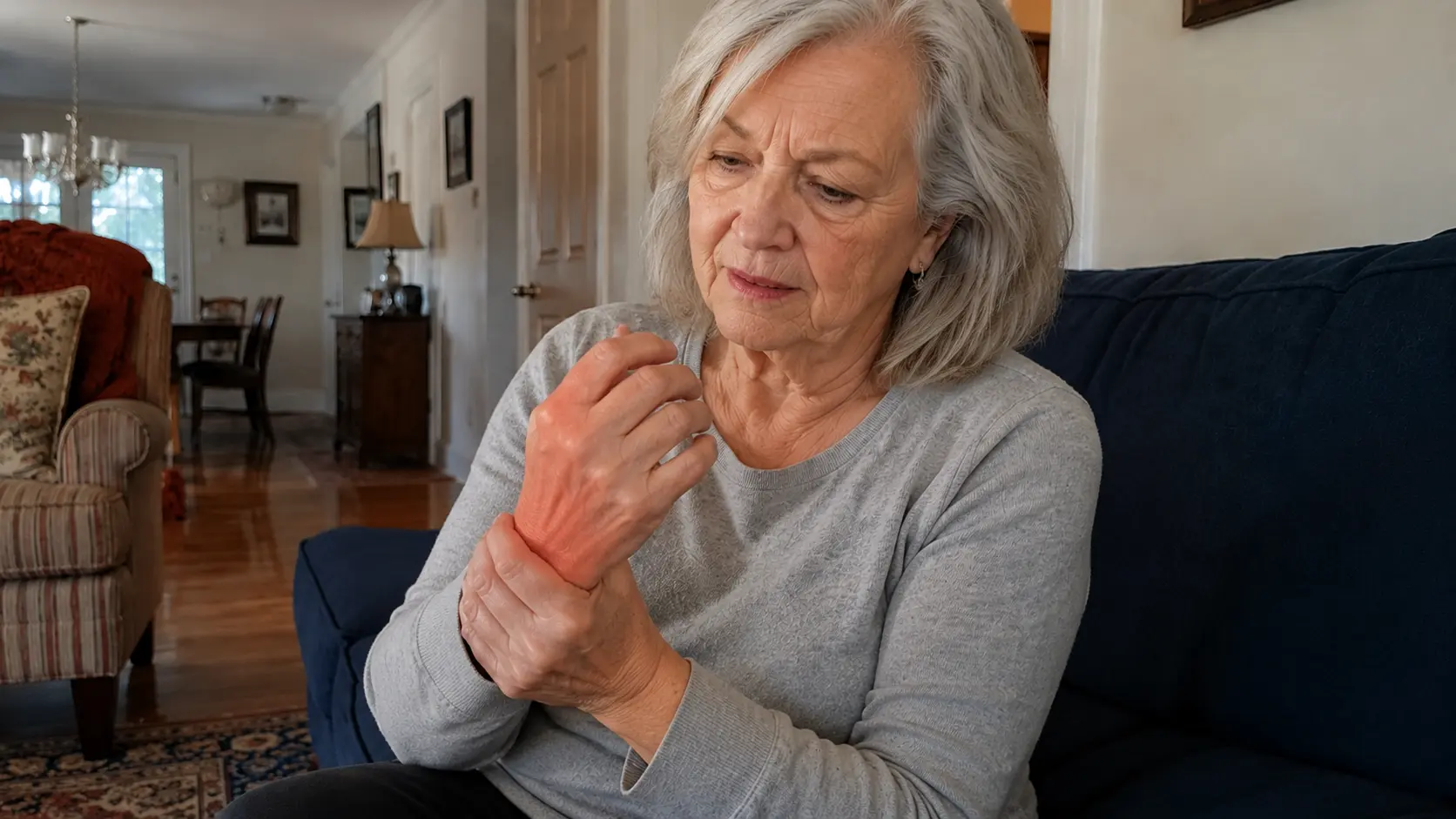
Dr. Reeves' mother, Eleanor, struggled with debilitating hand pain for years before he found an answer.
I need to tell you why this is personal for me. Because if I don't, you might think I'm just another doctor pushing another product. I'm not. This cost me something.
Three years ago, I watched my 74-year-old mother try to pick up her granddaughter's birthday cake at a family gathering. She'd baked it herself — chocolate, three layers, her famous recipe. She carried it to the table with both hands, and halfway there, her fingers just... opened.
The cake hit the floor. My niece started crying. My mother stood there looking at her hands like they'd betrayed her. And in a way, they had.
My mother had been diagnosed with osteoarthritis in both hands at 66. By 70, she'd also developed carpal tunnel syndrome. And over the next four years, I watched her get passed from specialist to specialist like a medical hot potato. Each one treated their piece. None of them saw the whole picture.
Rheumatologist — Dr. Kessler
Prescribed methotrexate for the arthritis. Mom took it for 14 months. The nausea was constant. The joint swelling? Barely changed. He upped the dose twice. When she complained about the numbness in her fingers, he said: "That's not my department."
Cost: $200/visit × 12 visits + medications = $4,200
Pain Management Specialist
Six cortisone injections over two years. Each one hurt. Each one worked for 6-8 weeks. Then the pain came roaring back, worse every time. By injection four, the relief window had shrunk to three weeks. He offered a seventh. She declined.
Cost: $350/injection × 6 = $2,100
Orthopedist — Carpal Tunnel Specialist
Fitted her with custom wrist braces. Ordered nerve conduction studies. Confirmed "moderate carpal tunnel syndrome." Recommended surgery. When Mom asked about alternatives, he said: "You can try living with it, but it won't get better on its own." His surgical scheduler called her three times.
Cost: Braces + tests + consults = $3,400
Physical Therapist — 16 Weeks
Hand exercises, grip strengthening, ultrasound therapy. She was diligent — never missed a session. After four months, her grip strength improved by maybe 10%. Her numbness? Unchanged. Her morning stiffness? Unchanged. The therapist shrugged and said: "Sometimes this is as good as it gets."
Cost: $175/session × 32 sessions = $5,600
Total: over $15,300 in two years. Four specialists. Six injections. Sixteen weeks of therapy. Four medications. Custom braces she wore to bed every single night. And after all of it — she still couldn't hold a birthday cake.
And standing in that kitchen, watching chocolate cake slide across her floor, watching her face crumble with it — I made a decision.
I was going to find what was actually wrong. Not the arthritis. Not the carpal tunnel. The thing underneath both of them. The root cause that no one was looking at because there was too much money in treating the symptoms separately.
What I found changed everything. For her. For my patients. And if you keep reading, potentially for you.
The Mind-Blowing Discovery That Changes Everything
Here's what 22 years of specializing in hands taught me — and what most doctors either don't know or won't say:
Arthritis and carpal tunnel syndrome are not two separate problems. They are two symptoms of the same underlying disease process.
Let me explain. And I'll keep it simple because you don't need a medical degree to understand this.
Inside your wrist, there's a narrow passageway about the diameter of your index finger called the carpal tunnel. The median nerve — the nerve responsible for sensation and movement in most of your hand — runs through this passageway along with nine flexor tendons.
When the tissue surrounding those tendons becomes chronically inflamed — from arthritis, from repetitive use, from the natural aging process, or most commonly, from a combination of all three — that passageway starts to shrink.
The nerve gets compressed. Squeezed. Strangled. Suffocated.
This is the part your doctors aren't connecting:
Arthritis causes inflammation → Inflammation swells the tissue → Swollen tissue compresses the nerve → Compressed nerve causes numbness, tingling, loss of grip → Loss of grip makes you compensate → Compensation creates more strain → More strain causes more inflammation.
That's The Tunnel Squeeze. A vicious, self-reinforcing cycle. And every treatment you've tried — every brace, every pill, every injection — addresses one point on the cycle without breaking the cycle itself.
That's why 43% of adults over 50 who have arthritis also develop carpal tunnel syndrome. That's not a coincidence. It's cause and effect. But because a rheumatologist treats one and an orthopedist treats the other, nobody is treating the connection.
Your inflammation is the engine. Everything else — the numbness, the stiffness, the swelling, the electric shocks, the loss of grip, the 2 AM wake-ups — those are just the exhaust.
Kill the engine, and the exhaust stops.
That was my breakthrough. And it led me to a technology that does exactly that.
What's Really Happening Inside Your Hands Right Now (And Why "Wait and See" Is the Worst Advice You'll Ever Get)
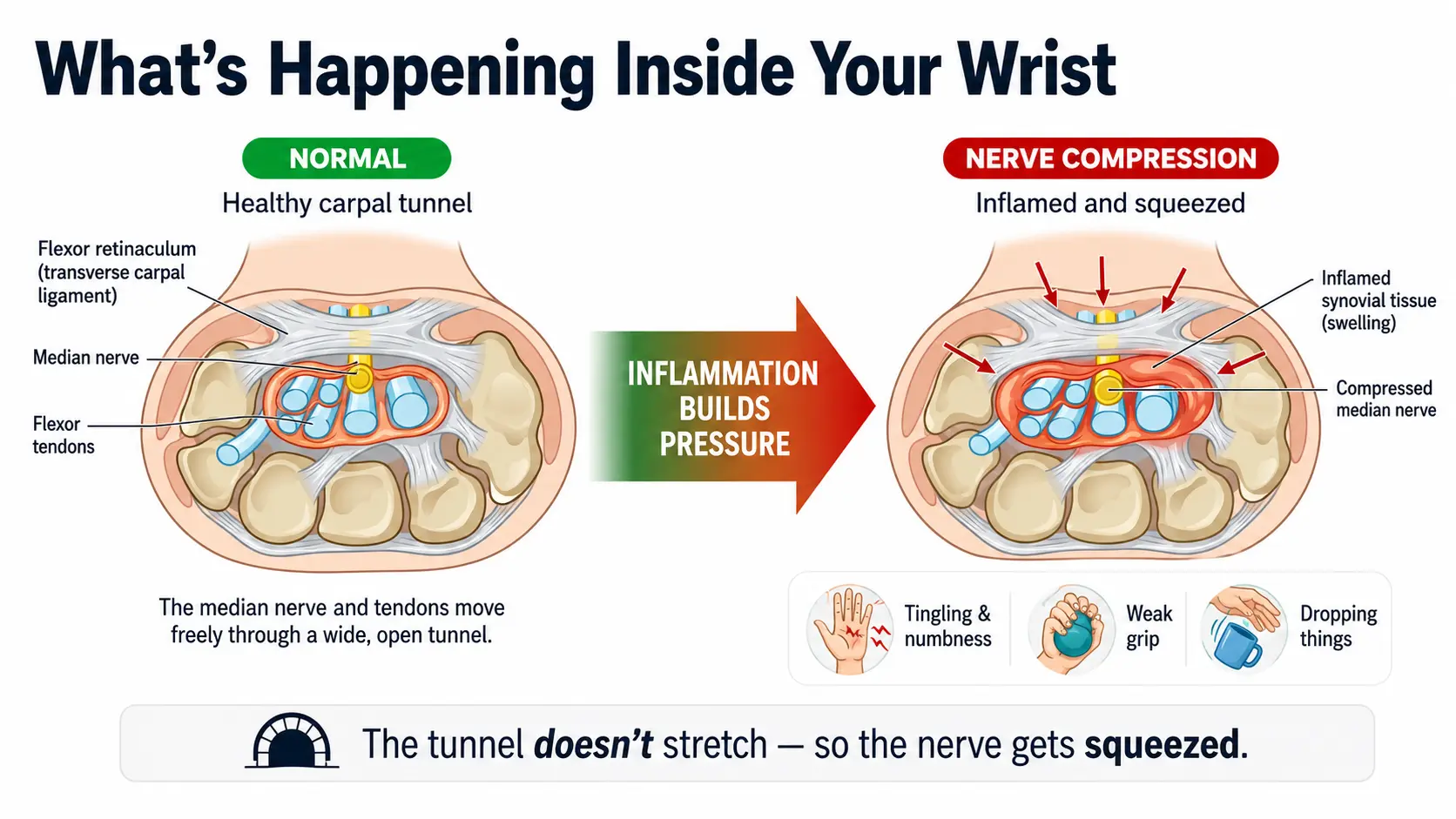
The carpal tunnel: a narrow passage where inflamed tissue strangles the median nerve.
Let me be direct with you, because nobody else will.
The Tunnel Squeeze inside your wrist is causing progressive, cumulative nerve damage. Every single day that your median nerve sits squeezed inside that inflamed tunnel, it loses function. Slowly. Silently. Irreversibly.
Here's the progression I've watched unfold in thousands of patients:
Stage 1 (Where most of you are now): Intermittent tingling, morning stiffness, occasional numbness. Knuckles ache when it's cold. You shake it off. You assume it'll get better on its own.
Stage 2 (6-18 months without intervention): Numbness becomes constant. Pain radiates up into your forearm. You start dropping things — your phone, your coffee cup, your keys. You can't open jars. You struggle with buttons. Your joints swell visibly. You can't tell hot from cold with your fingertips.
Stage 3 (The point of no return): The muscle at the base of your thumb — look at it right now, compare it to your other hand — begins to visibly shrink. This is called thenar atrophy. Once it starts, it does not reverse. The nerve damage becomes permanent. Your hands will never fully recover.
I am not telling you this to frighten you. I'm telling you because I've watched this progression destroy the independence of thousands of patients who sat in my office and said the exact same thing: "I thought it would just go away."
It doesn't go away. It gets worse. Every single time. Without exception.
My mother was at Stage 2 when I found the answer. Some of you reading this are already there. Some of you are approaching Stage 3. And every day you wait is a day you can't get back.
➜ See the Breakthrough Treatment HereFree shipping · 90-day risk-free guarantee · Summer sale pricing
Why Everything You've Tried Has Failed (And It's Not Your Fault)
If you've been dealing with hand pain, numbness, or stiffness for more than a few months, you've probably tried some combination of the following. And every single one has let you down.
Anti-inflammatory medications. NSAIDs like ibuprofen dull the pain signal by reducing inflammation systemically — but they can't concentrate their effect on the tiny, specific area inside your carpal tunnel where the damage is happening. You're carpet-bombing your entire body to hit a target the size of your thumb. And the long-term side effects — stomach ulcers, kidney damage, cardiovascular risk — make daily use a dangerous gamble. You're turning down the volume on a smoke alarm while the house burns.
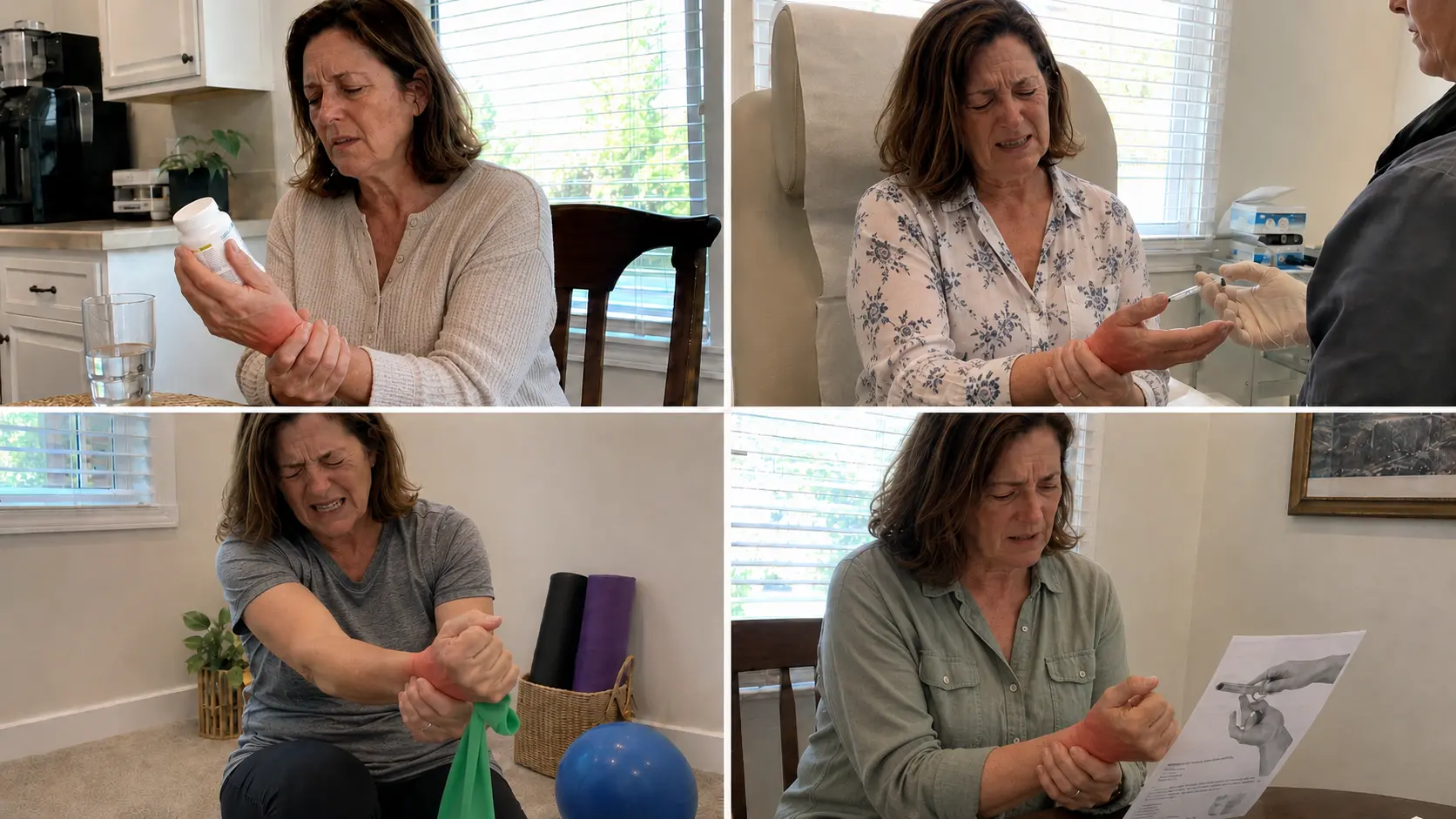
Cortisone injections. A needle into your carpal tunnel. Temporary relief — usually 6 to 12 weeks. Then the inflammation roars back, often worse than before. And with each injection, the effectiveness drops. Your doctor knows this. They'll give you three, maybe four shots before telling you "we've done all we can conservatively." At $300-$500 per injection, that's $1,500+ for temporary relief that evaporates.
Physical therapy. At $150-$200 per session, two sessions a week, you're looking at $1,200-$1,600 per month. Some patients see moderate improvement. Most plateau after 8-10 weeks. The exercises can help — but they can't penetrate the tissue where the damage is actually happening. They strengthen the muscles around the problem without ever touching the problem itself.
And then there's the option your doctor eventually brings up with a serious face:
Surgery.
Carpal tunnel release surgery costs between $5,000 and $10,000. It requires weeks of recovery. You can't grip anything, drive, or work for 4-6 weeks minimum. And here's the statistic the surgeon won't volunteer: according to published medical research, up to 57% of carpal tunnel surgeries result in recurring symptoms within five years.
Fifty-seven percent.
Let me say that differently: there's better than a coin-flip chance that after paying $10,000 and missing six weeks of work, you end up right back where you started.
And if you also have arthritis? The surgery doesn't touch it. You still have inflamed joints. You still have swelling. The same inflammation that caused the compression in the first place is still there, quietly squeezing the nerve again.
Ask yourself this: if hand surgery had a reliable, permanent success rate, why does the American hand surgery market generate $4.8 billion every year — and growing? Repeat customers aren't a bug in their business model. They're the feature.
I don't say this to vilify surgeons. Many of them are talented, well-intentioned physicians. But I've been in this field long enough to understand the economics: a patient who's cured is a customer lost.
So when I discovered something that actually works — something that addresses the root cause instead of masking the symptoms — I wasn't surprised that nobody was talking about it.
I was furious.
The 15-Minute Miracle
After the cake incident with my mother, I spent three months doing something I'd never done in 22 years of practice. I stopped looking at symptoms and started looking at mechanisms.
I reviewed over 200 peer-reviewed studies. Research from Harvard Medical School. NASA. The National Institutes of Health. Boston University School of Medicine. Studies on a technology that had been quietly accumulating evidence for over two decades while the mainstream medical establishment looked the other way.
The technology is called photobiomodulation — PBM for short, because we don't need a ten-dollar word.
And the results I was reading were, frankly, difficult to believe.
PBM uses specific wavelengths of red and near-infrared light to penetrate tissue at the cellular level. This isn't a heat lamp from the drugstore. This isn't a UV tanning bed. This isn't "alternative medicine" or wishful thinking.
PBM has been the subject of over 5,000 peer-reviewed clinical studies. NASA used it to accelerate wound healing in astronauts. Harvard Medical School has published extensively on its mechanisms. The U.S. military uses it for traumatic brain injury recovery.
And Dr. Margaret Naeser at Boston University School of Medicine conducted a landmark study specifically on carpal tunnel patients. The result?
An 84% success rate treating carpal tunnel syndrome with red light therapy. More than 171 patients fully recovering. Not "improved." Not "managed." Recovering.
Here's what happens at the cellular level — and I'll keep this simple:
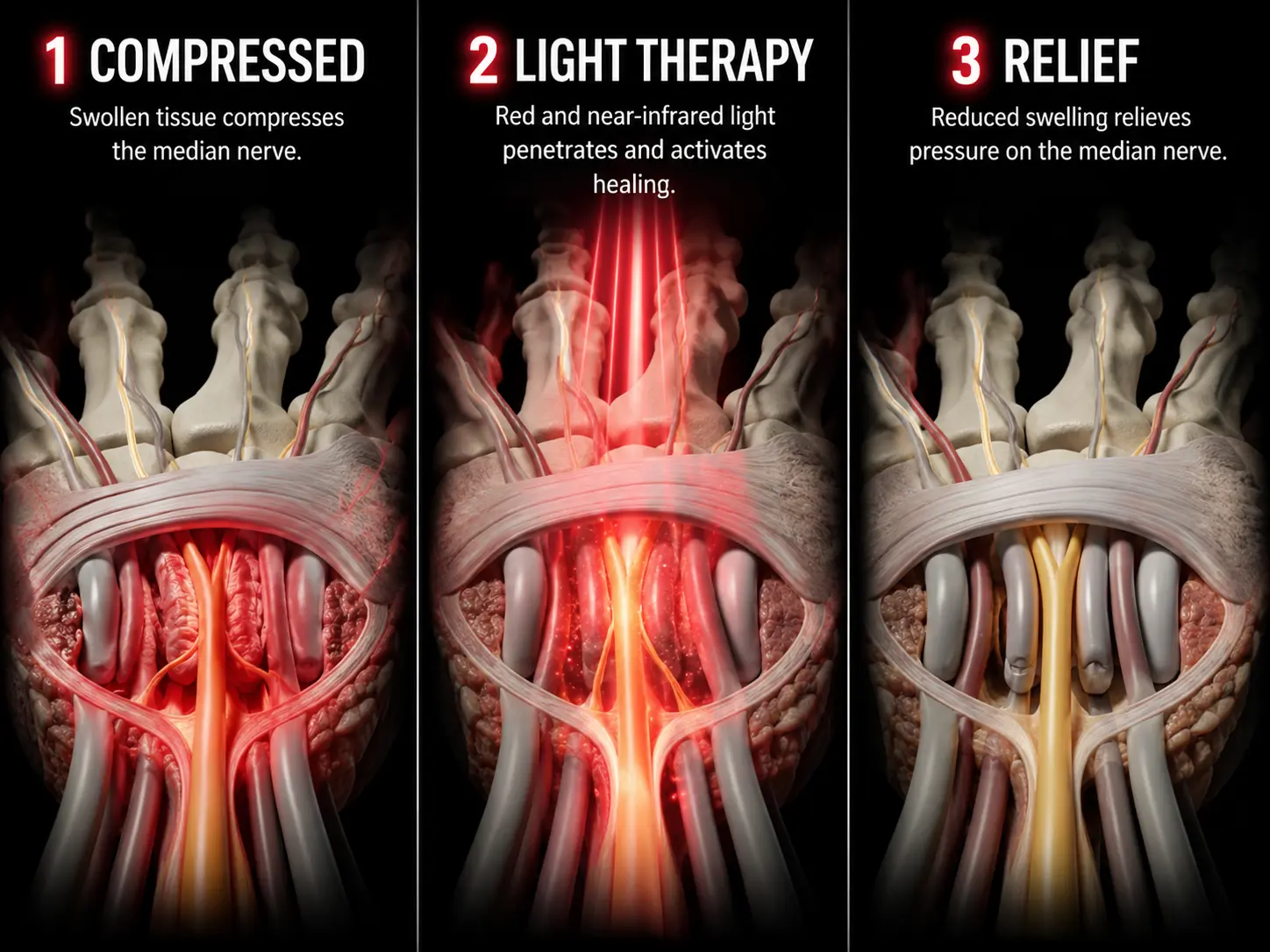
Minutes 0-5
The Flood: Blood Flow Surges to Starved Tissue
Red light at 660 nanometers penetrates the skin and triggers vasodilation — your blood vessels open up. Fresh, oxygen-rich blood rushes into the compressed area inside your carpal tunnel. The inflamed, oxygen-starved tissue that's strangling your nerve gets its first breath of fresh air. Your hand starts to feel warm. Not from heat — from circulation. The exact opposite of what a wrist brace does.
Minutes 5-10
The Repair: Cells Power Up From the Inside Out
Near-infrared light at 850 nanometers penetrates deeper — through skin, muscle, and connective tissue — directly to the mitochondria of your cells. It stimulates production of ATP, the energy molecule that powers every cellular repair process in your body. Your damaged nerve cells literally get a surge of repair energy. Think of it like jump-starting a dead battery. Published studies show up to 70% reduction in pain and morning stiffness through this mechanism alone.
Minutes 10-15
The Kill Switch: Inflammation Gets Shut Down at the Source
The combination of both wavelengths triggers a measurable reduction in pro-inflammatory cytokines — the chemical signals that keep your tissue swollen, your joints aching, your nerve compressed, and your pain cycling endlessly. This isn't masking inflammation. It's switching it off at the molecular level. The inflammation that drives BOTH your arthritis AND your carpal tunnel gets suppressed at the source. One mechanism. One treatment. Both conditions.
After 15 minutes? You stand up differently. You flex your fingers and something feels... different. Not "less painful for a few hours." Differently. Your hand feels like it has circulation again. Like someone turned the blood supply back on. Your fingers feel warmer. More alive. The constant background hum of tingling — the one you've gotten so used to that you forgot it wasn't normal — goes quiet. The Tunnel Squeeze loosens its grip. And for the first time in months, maybe years, you think: "Oh. This is what my hands used to feel like."
This is the key difference. Every other treatment you've tried — the braces, the pills, the injections, the arthritis meds — works around the problem. PBM works on the problem. At the cellular level. Where the damage actually lives.
When I read these studies, I had one question: Why isn't every hand clinic in America using this?
Then I looked at the economics, and the answer became painfully obvious.
Why They Don't Want You to Know About This
A PBM device costs a fraction of a single cortisone injection. There's no recurring office visit. No follow-up surgery. No prescription to refill. Once a patient has one, they don't need the doctor anymore.
And that, right there, is why you've never heard about it from your physician.
Let me put this in dollars. The hand and wrist pain treatment industry in the United States generates:
$4.8 billion in hand surgeries per year
$2.3 billion in wrist braces and supports
$1.7 billion in cortisone and joint injections
$8.2 billion in arthritis medications
That's over $17 billion per year that depends on you staying in pain.
When I started recommending PBM therapy publicly, something happened that I didn't expect but probably should have.
I got a letter from a law firm.
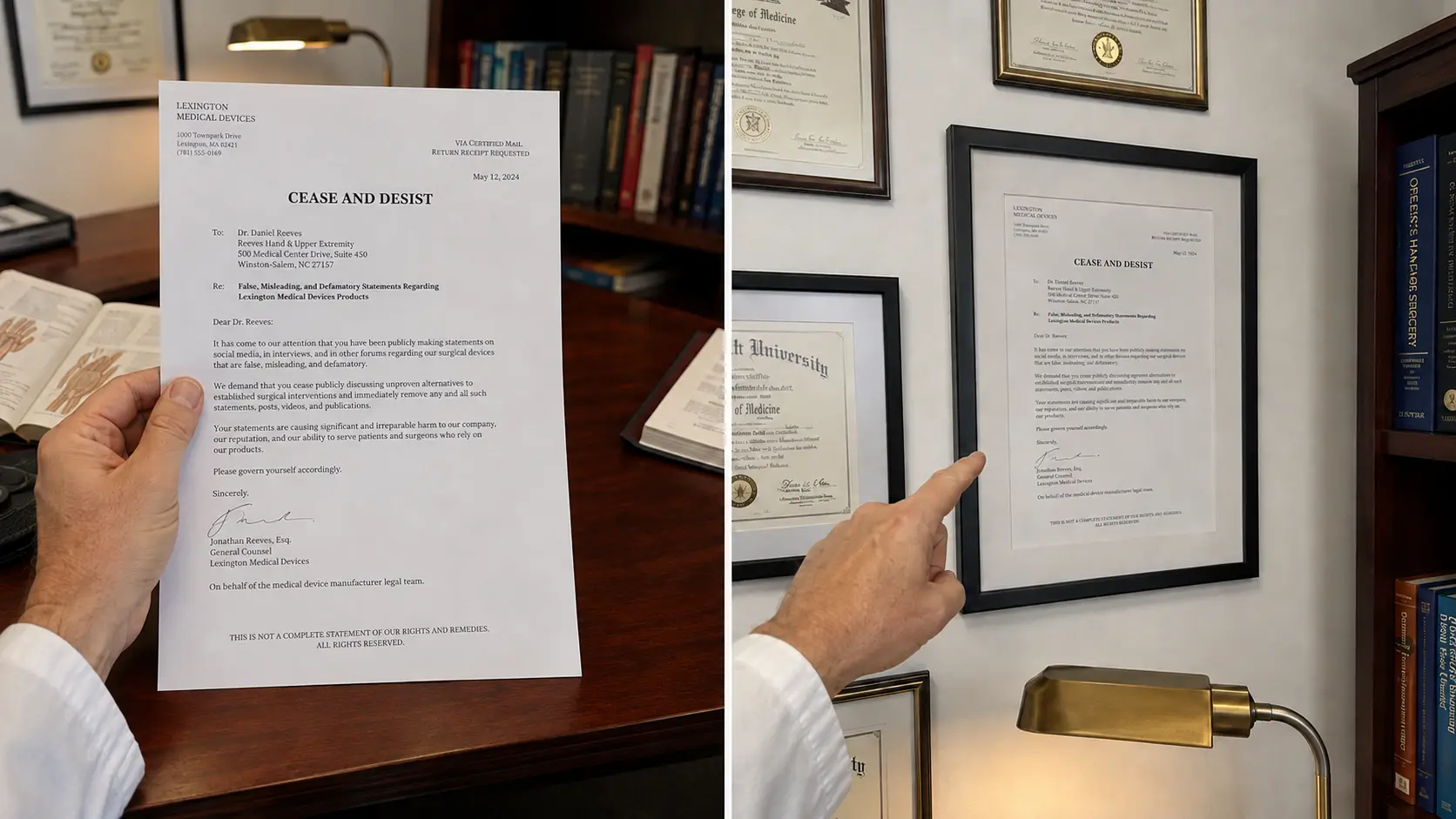
Not a malpractice suit. A "cease and desist" from a major medical device manufacturer's legal team, asking me to stop publicly discussing "unproven alternatives to established surgical interventions."
Unproven. Over 5,000 peer-reviewed studies. An 84% success rate in clinical trials. Used by NASA, the military, and elite sports medicine facilities worldwide. "Unproven."
I framed that letter. It hangs in my office. Because when a $17 billion industry sends lawyers after you, you know you're over the target.
➜ See What They Don't Want You to KnowThe breakthrough they tried to suppress · 90-day risk-free trial
TheraWrap: The Device I Now Recommend to Every Patient
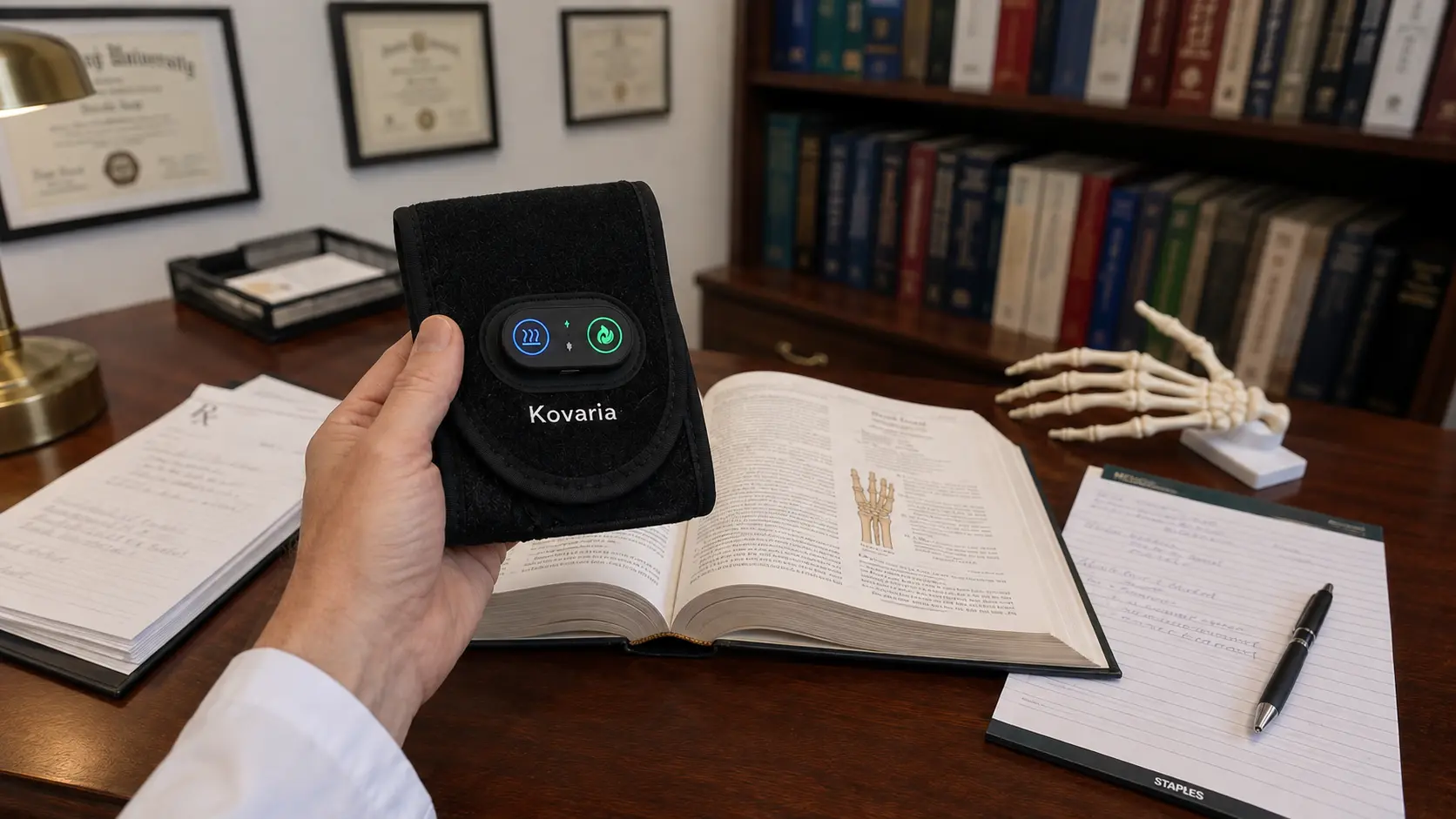
After reviewing the clinical literature, I went looking for a PBM device that met clinical standards but was designed for home use. Most of what I found was either cheaply made, used the wrong wavelengths, or didn't have enough LEDs to deliver a therapeutic dose.
Then I found TheraWrap.
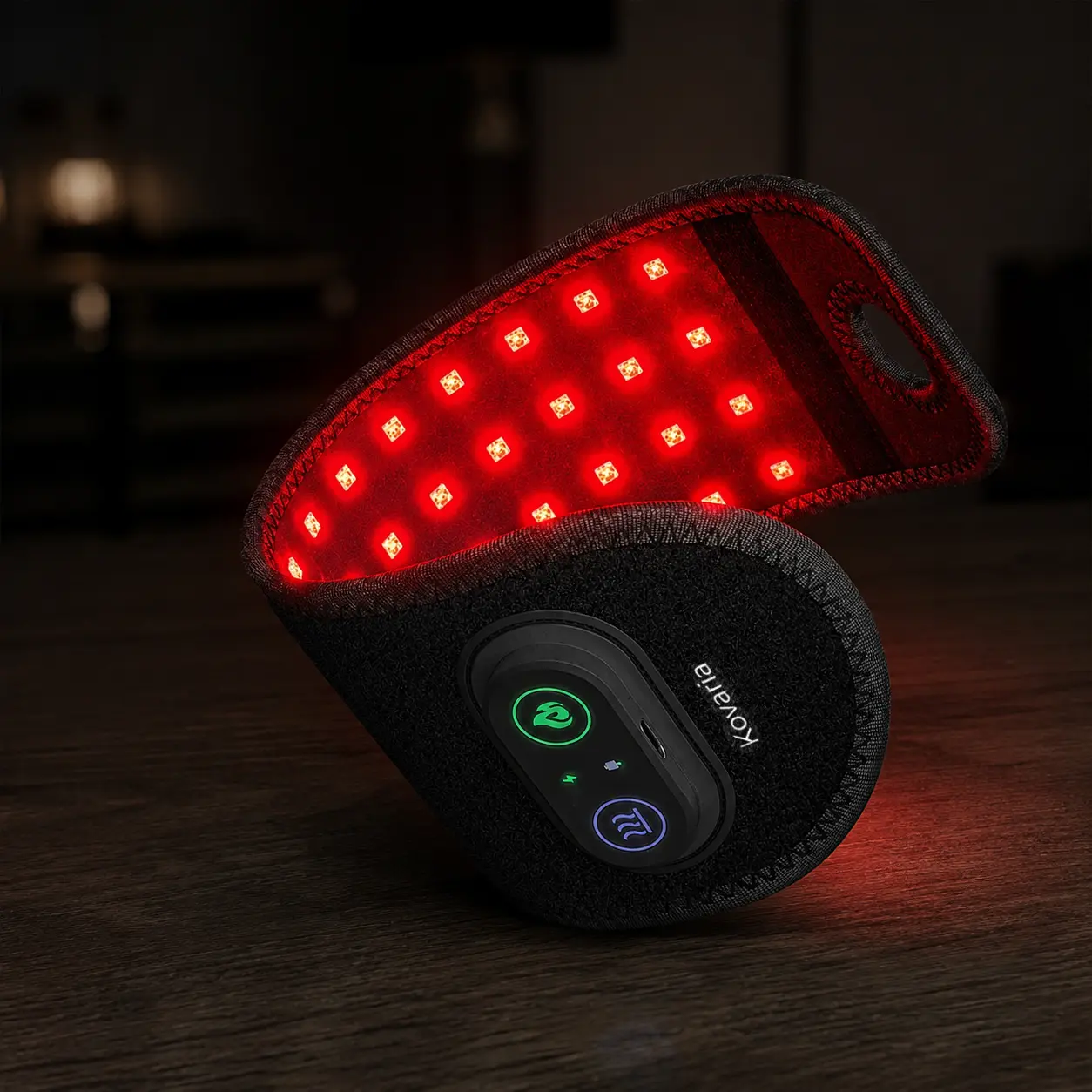
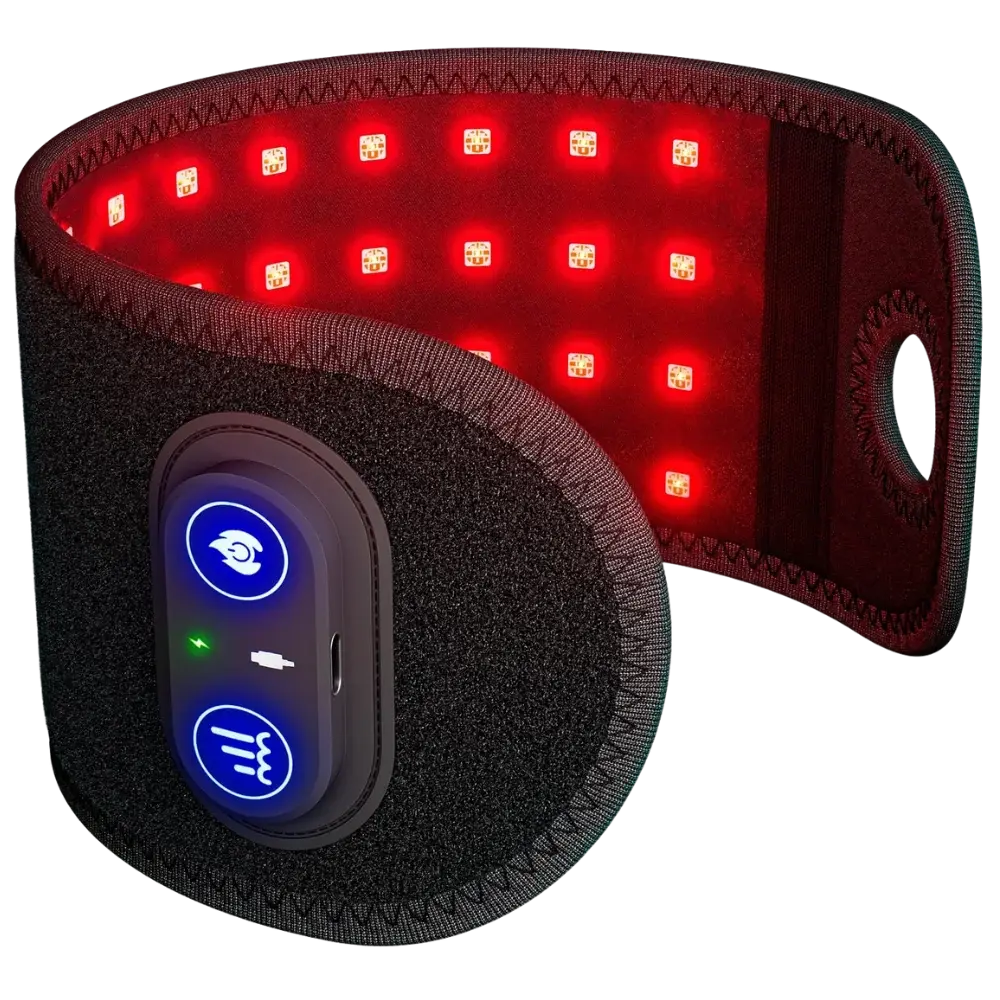
It's a wrist-worn device with 48 medical-grade LED chips — 24 red (660nm) and 24 near-infrared (850nm) — arranged in a precise pattern that delivers both wavelengths simultaneously to the entire carpal tunnel area.
It was built in an FDA-registered facility. It's been third-party tested for safety and electromagnetic compliance. It has 3 power levels and 4 therapy modes. It's cordless, rechargeable, and weighs just 126 grams.
You wrap it around your wrist. Press one button. Fifteen minutes later, it shuts off automatically. That's it.
No pills. No needles. No appointments. No recovery time. No side effects.
I gave one to my mother first.
What Happened to My Mother
She was skeptical. After $14,000 in failed treatments, who wouldn't be? But she trusted me enough to try.
I told her: "Mom, use it for 15 minutes every evening. Don't change anything else. Don't stop your medications. Just add this."
She called me on day three.
"David," she said, and her voice was different. Lighter. "I slept through the night. I haven't slept through the night in eleven months."
At one week, her morning stiffness — the kind where she couldn't make a fist until noon — was down by what she estimated was 60%.
At two weeks, her daytime numbness had dropped dramatically. She could feel the TV remote in her hand again.
At four weeks, she picked up a jar of pasta sauce at the grocery store. Opened it herself. She stood in the aisle and cried.
At six weeks, she called her rheumatologist and reduced her arthritis medication. Her joint swelling was visibly decreased. Her fingers were moving more freely than they had in years.
At three months, she baked another chocolate cake. Three layers. She carried it to the table with both hands. This time, she didn't drop it.
She put it down, looked at me across the room, and said:
"I forgot what my hands used to feel like. I forgot they used to hurt."
My mother was the first person I gave TheraWrap to. She was not the last.
The Patient Who Made Me Go Public
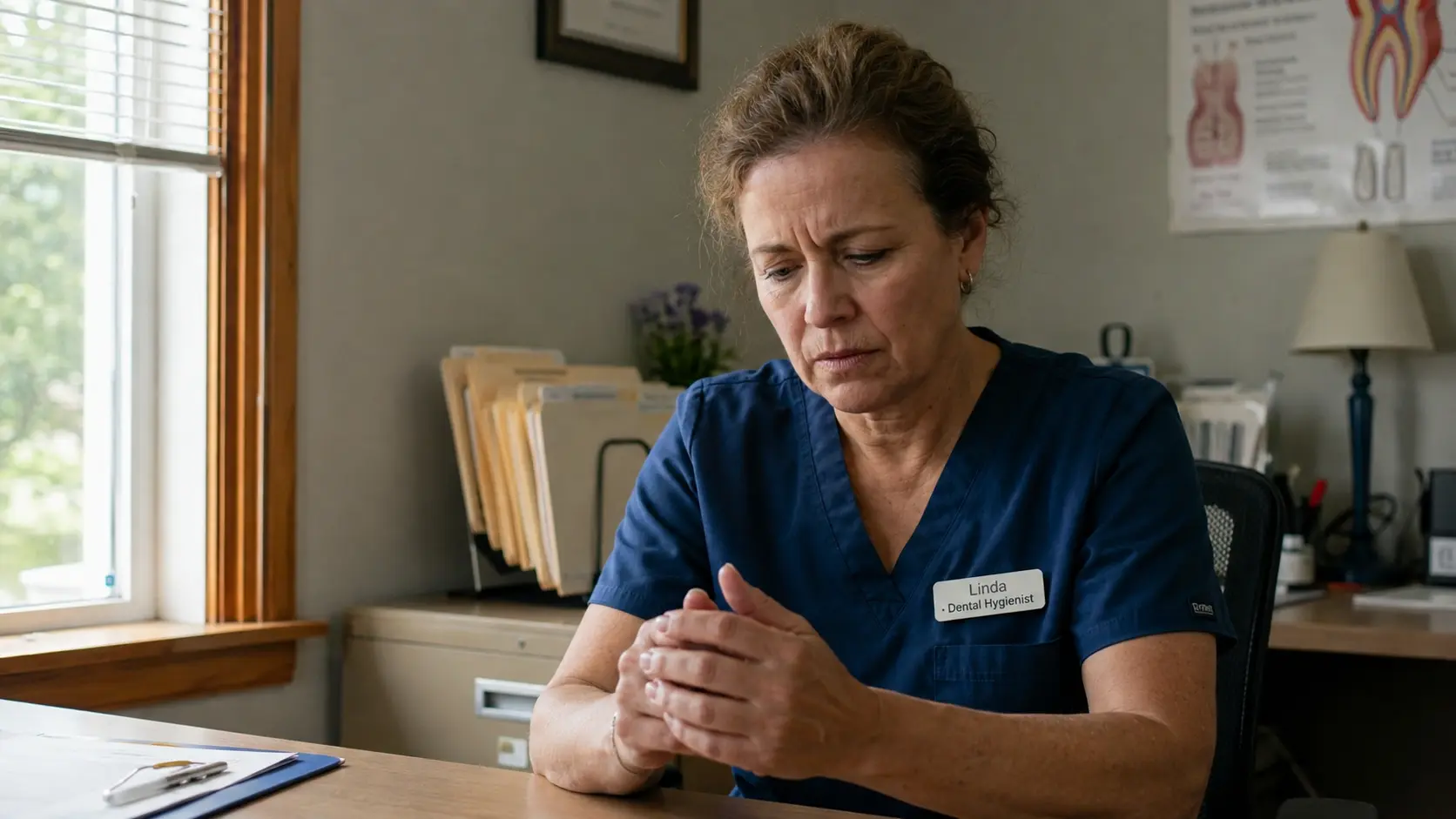
Shortly after my mother's results, a dental hygienist named Linda Morales sat in my exam room in tears.
She was 54. She'd been dealing with worsening hand pain and numbness for almost two years. Her right hand had carpal tunnel. Her left had early-stage arthritis. Both hands were failing her — and for a dental hygienist who uses precise hand movements eight hours a day, that was a career death sentence.
She'd already tried everything — braces, cortisone injections, four months of physical therapy. Nothing held.
"I can't feel my instruments anymore," she told me. "I'm gripping them so hard to compensate that my forearms are cramping by noon. I'm 54 years old, Dr. Reeves. I can't afford to retire. And I can't keep doing this."
Her surgeon had scheduled a carpal tunnel release for the following month. But Linda had read about the recurrence rates. She came to me looking for anything that might give her a real chance.
I gave her a TheraWrap. Told her 15 minutes every evening.
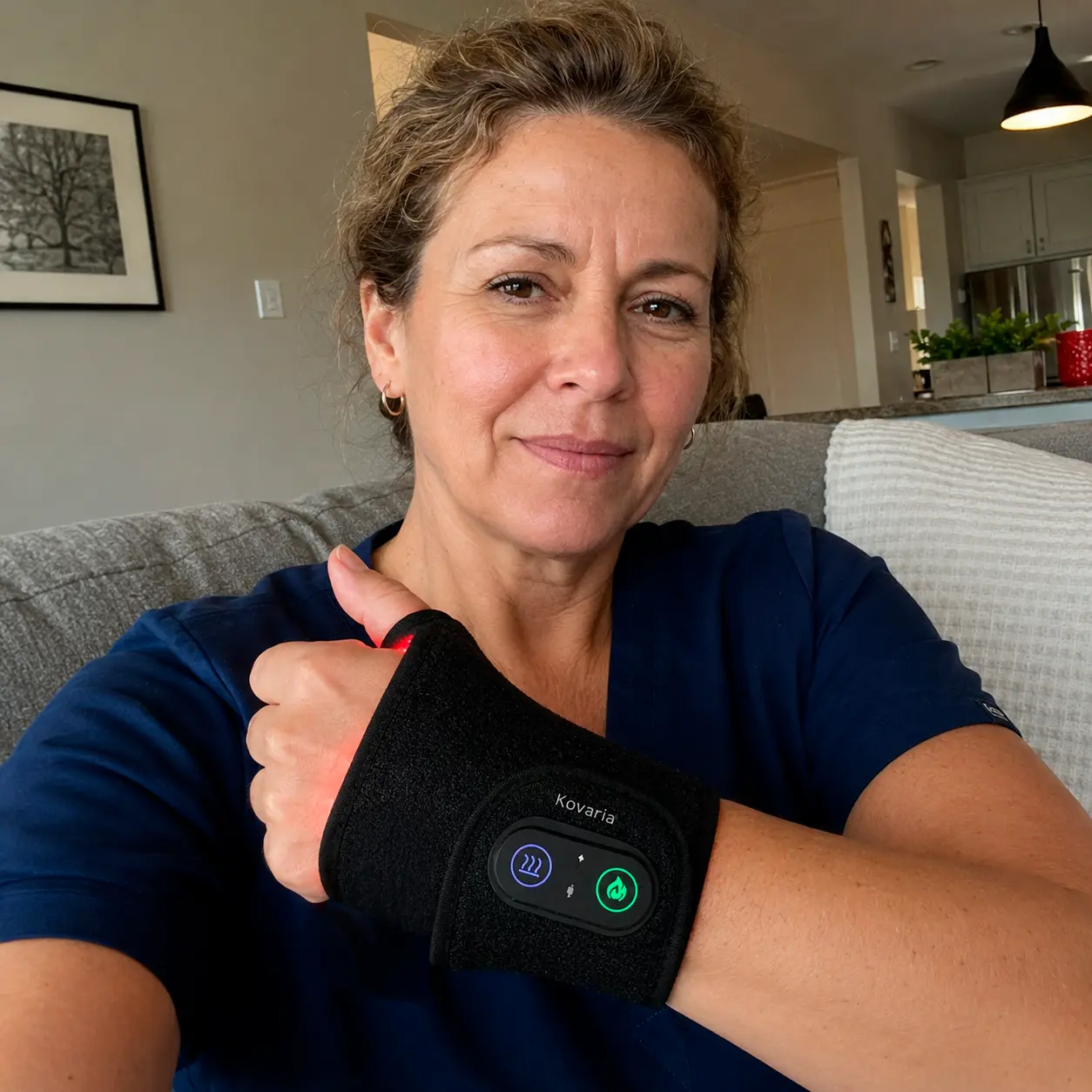
At two weeks: daytime numbness decreased by 60-70%. Grip strength measurably improved. Forearm cramping stopped entirely.
At six weeks: she cancelled her surgery.
At three months, she was working full days without pain. Both hands. Carpal tunnel AND arthritis — both improving from the same device, the same 15 minutes, the same mechanism.
That's when I knew I couldn't keep this quiet anymore. Not when millions of people were suffering through the same failed treatments I'd been prescribing for two decades.
The Numbers Don't Lie
After recommending TheraWrap to over 400 patients and tracking their outcomes, here's what the data shows:
*Based on patient-reported outcomes. Individual results may vary.
Read those numbers again. 87% reduced numbness. 92% sleeping through the night. 81% less stiffness. 71% avoided surgery.
Find me another treatment in the hand pain space with those numbers. I'll wait.
➜ Try TheraWrap Risk-Free for 90 DaysJoin 12,000+ Americans who've found relief
What to Expect When You Start (Based on Clinical Data and Patient Reports)
Days 1-3: First Signs of Relief
Most users notice reduced nighttime tingling and improved sleep within the first few sessions. Morning stiffness begins to loosen.
Weeks 1-2: Daytime Pain Drops
Daytime numbness eases, grip strength returns, and joint swelling decreases visibly. You start doing things with your hands you'd given up on.
Weeks 3-6: Life Starts Coming Back
Sustained improvement in hand function. Buttons, jars, pens — not enemies anymore. Many patients considering surgery cancel their appointments.
Weeks 8+: Long-Term Hand Health
Pain becomes a memory. Patients return to hobbies they'd abandoned — guitar, gardening, woodworking. You get your life back.
What Others Are Saying
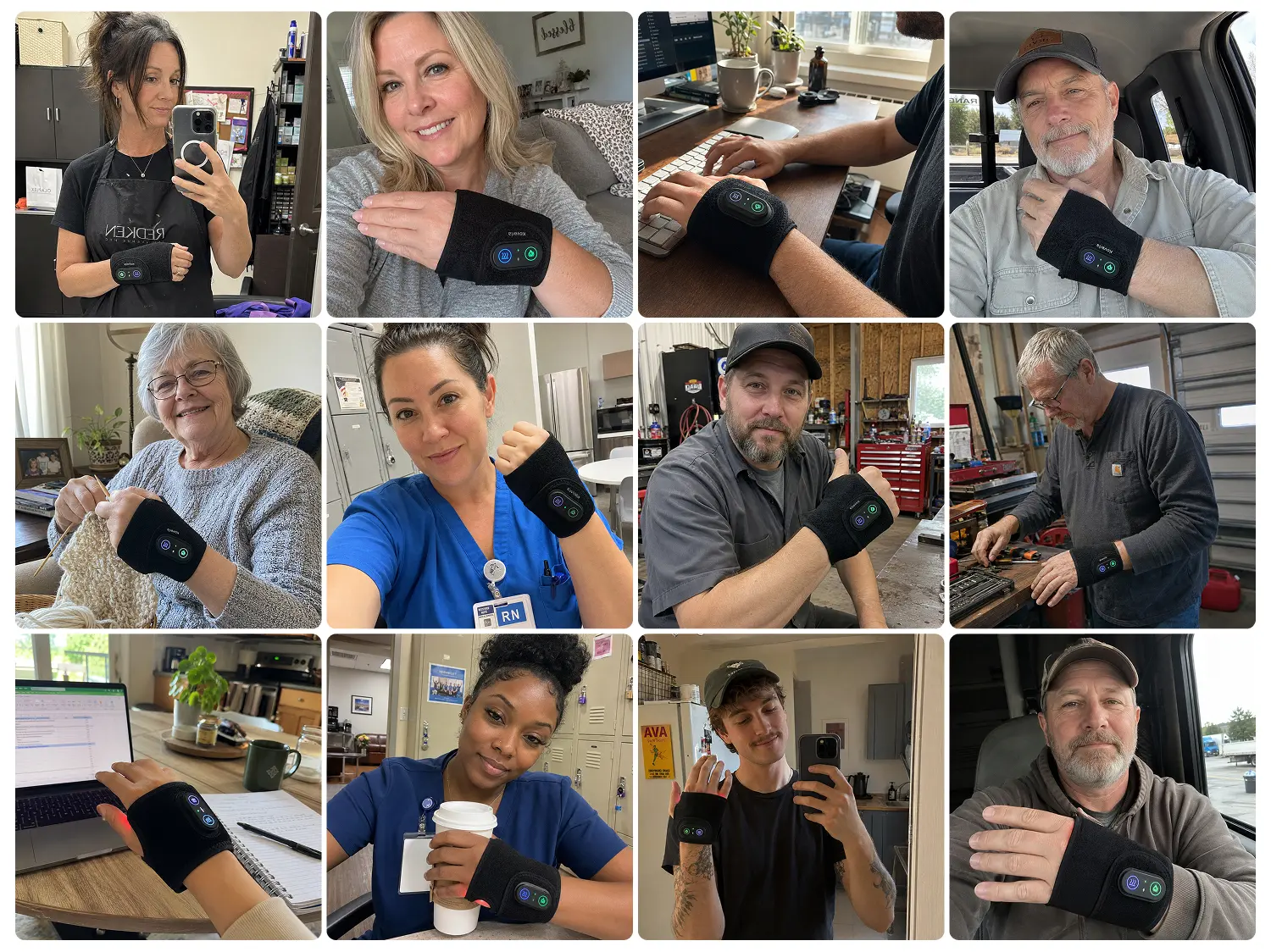
I started recommending TheraWrap to my patients. Then something unexpected happened — they started telling their friends. Their families. Their coworkers. The messages started flooding in. Here are just a few:


"I was two weeks away from surgery when my daughter found this. I almost didn't try it — I mean, $69 vs. a $7,000 procedure? How could it work? But I was desperate. Within 5 days the nighttime numbness was 80% gone. It's been 4 months now and I cancelled the surgery. My surgeon was not pleased. I don't care."
 Verified Purchase

"Retired contractor. 40 years of swinging hammers and running power tools destroyed my hands. Both wrists — arthritis and carpal tunnel together. My wife had to open jars for me. That's a hard thing to admit when you built houses for a living. I've been using TheraWrap on both wrists for 6 weeks. Yesterday I changed a flat tire by myself. I sat in the truck afterward and cried. I'm 64 years old and I cried."
Verified Purchase

"I'm a pianist. Was a pianist. The arthritis took my knuckles first — stiff, swollen, aching. Then the carpal tunnel took my feeling. I couldn't feel the keys. I stopped playing in January. Started TheraWrap in March. By April I was playing again. Chopin. With feeling in every finger. I will never be able to explain what that meant to me."
Verified Purchase

"My doctor told me to 'learn to live with it.' That's a direct quote. Learn to live with it. At 56. Arthritis in both hands, carpal tunnel in my right. I ordered TheraWrap that same night out of pure spite. Best decision I ever made fueled by anger. Three weeks in — the tingling is almost completely gone, my joints don't ache in the morning, and I'd love to go back and tell that doctor what I think of his advice."
Verified Purchase
"Okay, But I've Been Burned Before."
I hear you. If you're skeptical, good. You should be. The internet is full of miracle cures that don't survive contact with reality. So let me address every objection you're forming right now — because I've heard them all.
"If this works, why hasn't my doctor told me about it?"
Because your doctor makes $0 from a device you buy once and use at home forever. They make $150 per cortisone injection. $200 per office visit. $5,000-$10,000 per surgery. I'm not questioning their integrity — I'm pointing out their economic reality. Most physicians are not incentivized to learn about treatments that eliminate the need for repeat visits. The research exists. The studies are published. But there's no pharmaceutical rep walking into your doctor's office pitching a device that costs less than dinner for two.
"This seems too cheap to actually work."
LED technology has become remarkably affordable. The wavelengths are identical to those used in clinical studies with $15,000 professional devices. The difference is the housing and the brand name on the box — not the light itself. Photons don't care whether they come from a $15,000 machine in a clinic or a well-engineered home device on your kitchen table. Physics is physics.
"I have arthritis AND carpal tunnel. Will one device help both?"
This is actually where TheraWrap shines brightest. Because the underlying mechanism — chronic inflammatory nerve and tissue compression — is the same for both conditions, the same dual-wavelength therapy addresses both simultaneously. You're not treating two problems. You're breaking one cycle. That's why 81% of my patients with combined diagnoses reported improvement in all symptoms, not just one set.
"What if it doesn't work for me?"
TheraWrap comes with a 90-day, no-questions-asked money-back guarantee. Use it every day for three months. If you don't experience meaningful improvement — in your sleep, your grip, your pain levels, your joint stiffness — send it back for a full refund. You don't even need to give a reason.
Think about that. When was the last time your surgeon offered to refund a $10,000 surgery if the symptoms came back?
🛡️ 90-Day Risk-Free Guarantee
Try TheraWrap for a full 90 days. If you're not satisfied for any reason, return it for a complete refund. No questions. No hassle. No fine print.
Want to know how confident we are? The current refund rate is 0.03%. That's three returns per ten thousand orders. Two of those were because a dog destroyed the device. The third was an accidental duplicate order. Virtually nobody sends it back. That should tell you everything.
Let's Talk About What This Actually Costs
I want to put something in perspective for you:
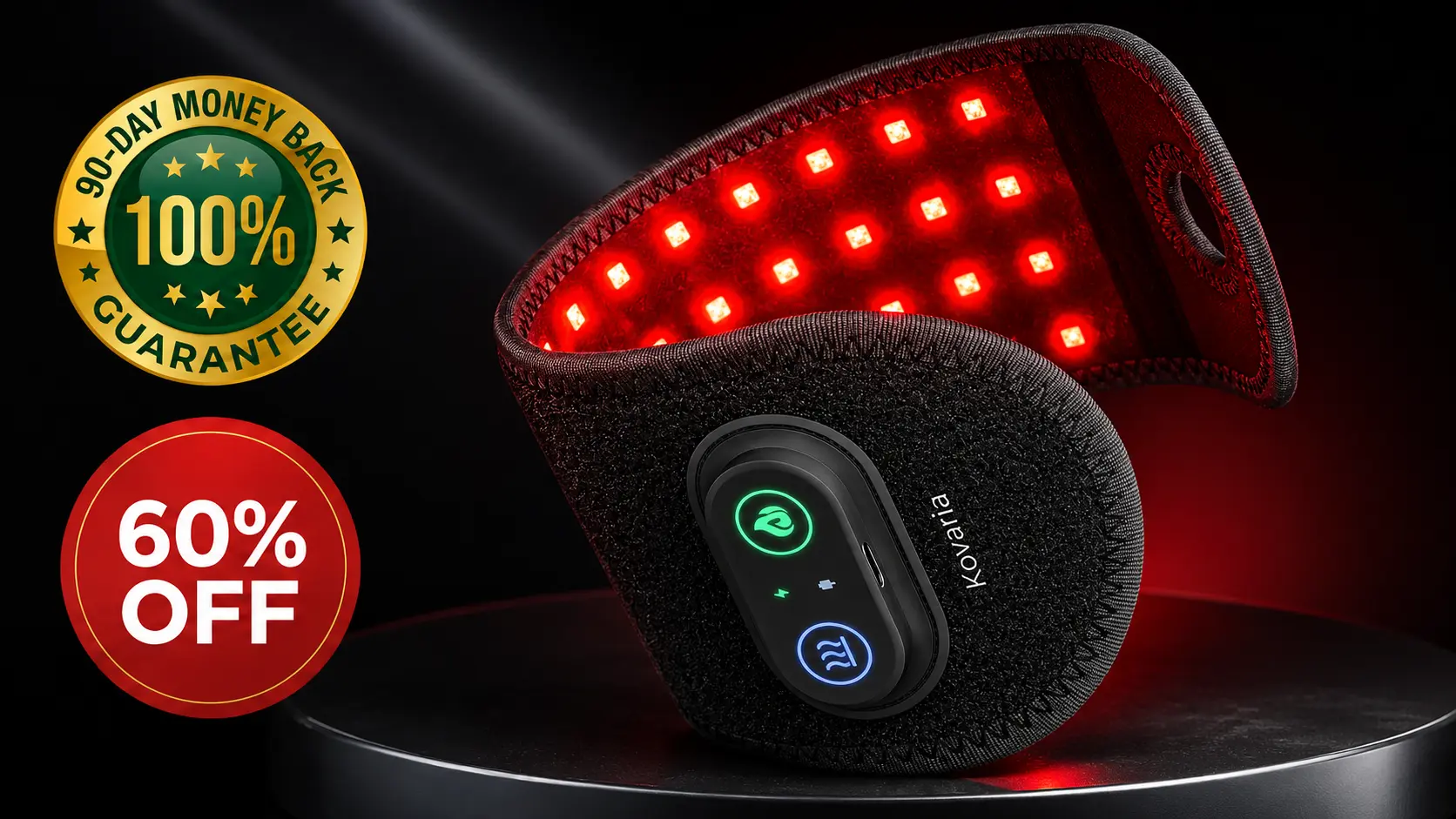
- Carpal Tunnel Surgery: $5,000 - $10,000
- Physical Therapy (6 months): $3,600 - $4,800
- Cortisone Injections (per year): $600 - $1,200
- Arthritis Medications (per year): $2,400 - $60,000
- Monthly Pain Medications: $30 - $90/mo forever
TheraWrap — One-Time Investment:
🔥 SAVE 50% — SUMMER SALE$139.96
$69.98
Free shipping · No subscriptions · No hidden fees · No recurring costs
⏰ This sale pricing expires in 72 hours.
 ⚡ Only 3,847 units left at the sale price
Read those numbers again. You could pay $10,000 for a surgery with a 57% recurrence rate and a six-week recovery. You could spend $60,000 a year on biologic arthritis drugs that suppress your immune system. Or you could try a clinically-backed device for less than the cost of dinner for two — with a 90-day guarantee that you have absolutely nothing to lose.
This isn't a close call. This isn't even a decision. This is arithmetic.
You Have Two Paths Forward

Path 1: Do Nothing
 Numbness spreads and becomes constant
- Joint damage becomes irreversible
- Sleep disruption worsens nightly
- Muscle atrophy begins (can't reverse)
- Surgery becomes the only option
- You lose your independence
Path 2: Try TheraWrap Today
 15 minutes a day, at home
- Targets BOTH arthritis & carpal tunnel
- Clinically-validated dual wavelengths
- 90-day money-back guarantee
- 50% off — just $69.98 (limited time)
- You get your life back
I've seen both paths. I've seen them thousands of times. The patients who act early — who address this while it's still in Stage 1 or Stage 2 — overwhelmingly get better. The ones who wait, who tell themselves "it's not that bad yet," end up in my office asking about surgery.
Don't be the person who waits until it's too late.
Exactly What to Do Right Now
Getting your hands back means getting your life back.
The "Up to 60% Off" Middle Finger to the Pain Industry
People ask me: "Why is this so cheap? If it really works, why isn't it $500?"
Here's the honest answer. The company behind TheraWrap came to me and asked what it would take to get this into as many hands as possible. My answer was simple: make it impossible to say no.
A $17 billion industry is built on you staying in pain. Every cortisone injection, every surgery consultation, every monthly prescription — that's recurring revenue. TheraWrap is a one-time purchase that makes all of that unnecessary. That terrifies them.
So we priced it at $69.98. Not because it's worth $69.98 — the clinical-grade LEDs alone cost more than that at wholesale. But because every person who buys one stops paying $300 for cortisone shots. Stops booking $200 office visits. Stops filling $90/month prescriptions. One TheraWrap sale costs the pain industry thousands in lost recurring revenue. That's the real discount — it's not a sale, it's a statement.
That's why the price won't last. At this margin, it's unsustainable. But while the summer sale is active and we still have inventory — I want as many people as possible to get one.
Imagine this: You wake up tomorrow morning and your fingers aren't stiff. You button your shirt without wincing. You hold your coffee cup without that dull, throbbing ache. You pick up your grandchild — or your dog, or your guitar, or a jar of pasta sauce — and your hands just... work. The way they used to. The way they're supposed to. That's not a fantasy. That's what 87% of TheraWrap users report within 30 days.
One Last Thing
I don't know how long TheraWrap will remain available at this price. When I first started recommending it, they were selling it for $139.96. The current price — $69.98 with free shipping — is a summer sale that I've been told expires in 72 hours. After that, the price goes back to $139.96. No exceptions.
I also don't know how long you have before your symptoms cross the line from reversible to permanent. I know you think you have time. Every patient who ended up needing surgery thought they had time too.
Try it. Use it for 90 days. If it doesn't change your life, send it back and you've lost nothing but 15 minutes a day.
But if it works — and based on the clinical evidence, the 5,000+ published studies, my mother's results, Linda's results, and the 12,000+ Americans who've already experienced this — I believe it will — you'll wish you'd done this months ago.
Your hands are worth 15 minutes and $70. You know they are.
With respect and urgency,
Dr. David Reeves, MD
Board-Certified Hand & Nerve Specialist · 22 Years Clinical Practice · 14,000+ Patients Treated
Don't Let Another Day Steal More From Your Hands
 INTERNET-ONLY OFFER
- Free Shipping
- 90-Day Guarantee
- 12,000+ Happy Users
- 0.03% Refund Rate
⚡ Only 3,847 units remaining — sale pricing expires in 72 hoursP.S. — Right now, try this: press the backs of your hands together with your fingers pointing down. Hold it for 30 seconds. If you feel tingling or numbness in your thumb, index, or middle finger — that's a positive Phalen's test. It's one of the standard diagnostic tests for carpal tunnel compression. If you just felt it, your nerve is already under pressure. Don't wait for Stage 3. Click here to try TheraWrap risk-free →
P.P.S. — Remember: every day you delay is another day your nerve sits compressed, oxygen-starved, and deteriorating. Another day your joints swell a little more. The damage accumulates silently. TheraWrap takes 15 minutes. Your decision to try it takes 15 seconds. Order now →
P.P.P.S. — Still unsure? Consider this: you're protected by a 90-day, no-questions-asked guarantee. If TheraWrap doesn't significantly reduce your pain, numbness, and stiffness — you get every penny back. The company absorbs the risk, not you. The only way you lose is if you do nothing and let your hands deteriorate for another 90 days while this sale is still available. Check availability now →